Top Signs You Need Garage Door Service – Don’t Ignore These
The clearest signs you need garage door service are a door that suddenly slows down, a grinding or popping noise during travel, uneven gaps at the bottom corners, visible vibration, or a door that reverses before it closes. Each of those symptoms points to a specific component, not a vague “something’s wrong.” If you’d rather not climb a ladder to diagnose it yourself, call (877) 492-2051 and we’ll sort out what’s actually failing.
Key Takeaways
- Slow travel upward usually means spring tension loss; slow travel downward usually means a track or roller problem. Same complaint, opposite fixes.
- Grinding is usually routine wear (rollers, bearings, opener gears). Popping or banging is a failure warning.
- A door resting higher on one bottom corner is a cable or drum issue, and it can eventually throw the door off its track.
- Door speed changes with the seasons in Melbourne. A door that behaved in January can bind or slam by August.
- Never adjust springs, cables or drums yourself. Those parts are under extreme tension and injure people who aren’t trained.
Why a slow garage door is really a load test
A garage door that opens more slowly than it used to isn’t just an annoyance. It’s a measurable load test, and it tells a technician something before the first tool comes out of the bag. The door’s travel speed is a direct readout of how much resistance it’s meeting on the way up or down. If the resistance has grown, some component is working harder than it was designed to.
Here’s where homeowners get stuck: they notice the door is slow and assume it’s the opener. In our experience, that’s often the wrong end of the system. The door is the largest moving part of your home, and the opener only lifts what the springs and track allow it to lift. Speed changes tell you which of those is losing the fight.
Two things to check before you call anyone:
- Does it feel slow equally in both directions?
- Does it feel slow only on the way up, or only on the way down?
Those two answers point to completely different problems, and they’re worth noting down before you pick up the phone.
Slow going up points to springs, slow going down points to track and rollers
This is the diagnostic split most homeowners never hear, and it changes the entire repair. A door that’s slower going up is usually fighting spring tension loss. The torsion or extension springs do most of the lifting, and when they weaken, the opener motors through the extra weight. A door that’s slower on the way down is usually meeting friction from the track, rollers or a misaligned rail, because gravity is fighting resistance rather than weight.
Why the direction matters:
- Slower up: spring tension loss, worn springs, or a balanced door drifting out of balance.
- Slower down: rollers binding in the track, a bent rail, debris, or a worn hinge.
- Slow in both directions: often the opener motor itself, or a door that’s no longer balanced at all.
Those are different fixes, different parts, and different levels of urgency. Spring work is the safety-sensitive end of the trade, and a failing spring can let go without warning. That’s not a job for a homeowner on a ladder. The local pro we connect you with is licensed and insured as Florida requires, and they’ll test balance and tension properly before recommending anything. If you’re smelling burning or hearing the opener strain, that’s the point to stop using the door and get it looked at.
Grinding vs. popping: which noise means imminent failure
Grinding is usually routine wear you can schedule. Popping or banging is usually a failure warning you shouldn’t wait on. They come from different parts of the system, and they call for different urgency.
Grinding, mechanically speaking, is metal dragging against metal or a dry bearing squealing on rotation. Most of the time it traces to worn rollers, dry hinges, or the opener’s internal gears. In our experience, a lot of grinding is a maintenance issue that’s gotten loud enough to be noticed. That’s a scheduled garage door repair, not an emergency.
Popping or banging is different. That sound is stored energy releasing suddenly. It can mean a spring is about to break, a cable is slipping off its drum, or a hinge has cracked under load. If you hear a bang and the door stops halfway or drops hard, treat it as a failure and stop operating it.
A quick way to remember it:
- Grinding: call soon, schedule it.
- Popping, banging, or a hard slam: stop using the door.
- A loud snap followed by a door that won’t lift: that’s usually a broken spring, and it needs a trained hand.
Either way, the noise is a clue, not a diagnosis. Your ear says something changed. The tech confirms which part.
The uneven bottom gap that predicts a track jump
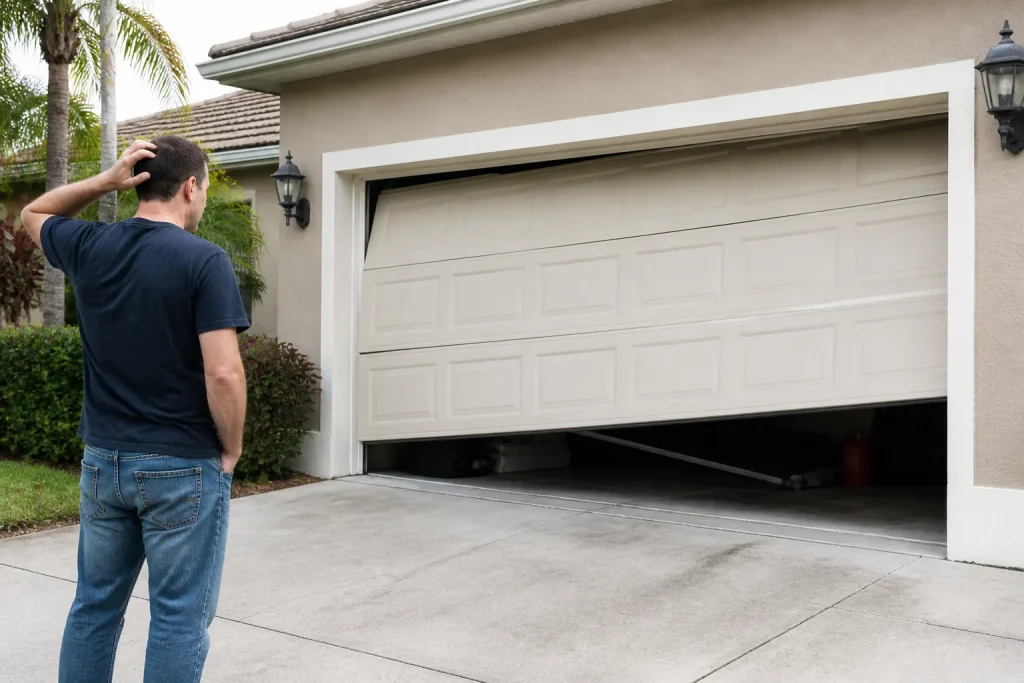
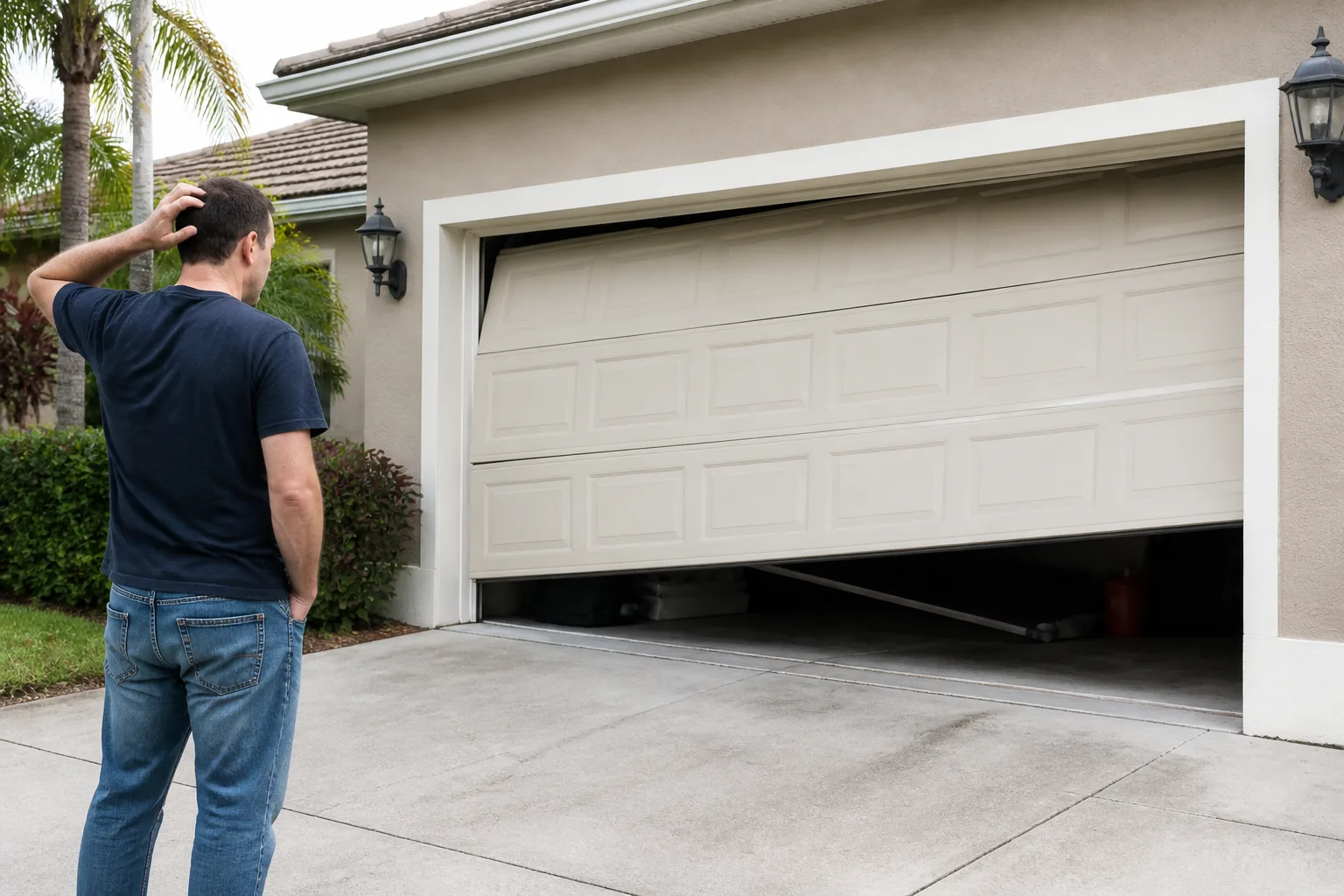
If your door sits higher on one bottom corner than the other, it isn’t a cosmetic alignment issue. An uneven bottom gap means the cables and drums are no longer pulling evenly on both sides. One side is lifting more than the other, and that’s the kind of imbalance that eventually throws the door off its track at full speed.
Here’s why it escalates. The door tracks on rollers in a fixed path. When the cables aren’t balanced, the door starts its travel out of square, and by the time it reaches the top it’s leaning. A small gap at the floor becomes a wobble at the top. A wobble becomes a roller that pops the track. That’s the point where a repair becomes a rescue.
What to look for around the bottom of your door:
- A visible gap under one corner that wasn’t there before.
- A door that looks slightly tilted when fully closed.
- Cables that appear slack on one side, or a drum that looks off.
- Squealing on the higher side during the last few inches of travel.
Cables are under high tension. Never loosen or adjust them yourself. Reach out and get a professional out to check the balance and the cables. If the door already jumped its track, that’s a stop-using-it situation until it’s fixed.
The vibration test: what your hand on the door frame tells you
There’s a five-second check you can run without touching a single moving part. Place your hand flat on the door frame while the door runs. A smooth, steady hum is normal. A pulsing or rattling vibration under your palm means roller bearing wear, loose hardware, or a track that’s out of alignment.
What different vibration patterns suggest:
- Constant steady vibration: often the opener motor or a worn opener gear.
- Pulsing once per roller pass: usually a flat-spotted roller bearing.
- Rattling that appears mid-travel: commonly a loose hinge or a track that’s shifted.
- A sharp knock at the top or bottom of travel: the door is hitting a stop it shouldn’t, or the track is pinched.
It’s a rough test, not a measurement, but it tells you whether to expect a small fix or a larger one. If the vibration is paired with any noise from the opener itself, the garage door opener repair side of the system is worth checking too. We work on the major brands, including Chamberlain and Genie, and the failure patterns on those systems are different enough that brand knowledge matters. Your hand just tells you it’s time for a look.
Why Melbourne weather changes your door’s behavior between January and August
Melbourne’s seasons swing between mild winters and hot, humid summers, and that swing affects spring tension calibration. A door that ran smooth in January can bind or slam by August without a single part being “broken.” Temperature changes move the door’s balance point, and if the springs were calibrated tight to the cooler months, summer heat can make them behave differently.
In our experience in Melbourne, this is where a lot of “the door just started acting up” complaints come from. It isn’t always a failure. Sometimes the door needs rebalancing for the season. The trick is telling the difference between a door that’s out of adjustment and one that’s actually failing, and that’s where the signs above come in.
What usually shifts with the weather:
- Spring tension: the door may feel heavier or lighter than in the other season.
- Track and rollers: humidity can affect how smoothly they travel.
- The opener: a motor working against a tight door in the heat runs harder and sounds louder.
If the door only misbehaves in one season, that’s a strong sign it’s an adjustment issue rather than a broken part. If it misbehaves all year, get it looked at. If you’re in Melbourne and the door acts up every summer, it’s worth a balance check before it becomes something bigger.
When to call a pro
Call a professional if you hear popping or banging, if the door has a visible uneven gap, if it won’t stay closed, or if the door reverses before it hits the floor. Those are all warning signs that involve loaded springs, cables, or the safety reverse system. A trained hand should look at all of them. A broken spring isn’t just an inconvenience. It’s a safety hazard that needs a trained hand.
If your door is slow, grinding, or vibrating, you’ve got more time, but not unlimited time. Small issues compound. A worn roller becomes a bent track. A worn track becomes a track jump. Getting ahead of it usually costs less than waiting. Our technicians have up to 13 years of experience, and they diagnose the brand-specific quirks in Clopay, Amarr, LiftMaster, Chamberlain, Genie, Craftsman, Wayne Dalton and Raynor systems rather than guessing. If you’re facing an emergency, we’ve built emergency garage door service as a named offering rather than a footnote.
Related services in Melbourne: garage door repair, garage door opener repair, and garage door installation when the door’s reached the end of its life and repair no longer makes sense.
The Bottom Line
Garage door symptoms aren’t random. Each one points to a specific part: direction of slowness tells you springs versus track, grinding means routine wear, popping means failure risk, an uneven bottom gap means cables and drums, and vibration tells you where the wear is concentrated. Add Melbourne’s seasonal temperature swings to the mix and a door that behaved in January can genuinely act differently by August.
If you’re in Melbourne and need help, Melbourne Garage Door Repair Pros offers free estimates. Call (877) 492-2051 and we’ll diagnose what’s actually going on before anything gets touched.
Frequently Asked Questions
Repair is usually the right call when the door is structurally sound and the problem is springs, rollers, cables or the opener. Replacement makes more sense when the door panels are warped or rusted through, the door is out of balance after multiple repairs, or the cost of repair gets close to the cost of a new door. A free estimate on site will tell you which side you’re on.
Grinding usually means metal is dragging on metal or a bearing is running dry. The most common causes are worn nylon or steel rollers, dry hinges, or the opener’s internal gears. It’s usually routine wear you can schedule rather than an emergency. Call (877) 492-2051 to get it inspected before it turns into something louder.
No. Torsion and extension springs are under extreme tension, and releasing that tension incorrectly can cause serious injury. Even experienced homeowners shouldn’t adjust or replace springs. Call a trained professional instead. Our technicians have up to 13 years of experience and treat spring repair as a core service, not an upsell.
Because spring tension is calibrated to a specific balance point, and Melbourne’s seasonal temperature swings shift that balance. A door that ran smooth in January can bind or slam in August without any part being broken. If the door only misbehaves in one season, it’s usually an adjustment issue. Call (877) 492-2051 for a balance check.
Written by the team at Melbourne Garage Door Repair Pros.
Need Garage Door Help?
Call Melbourne Garage Door Repair Pros - the local pro we connect you with is licensed and insured, here with fast after-hours help in Melbourne.
(877) 492-2051